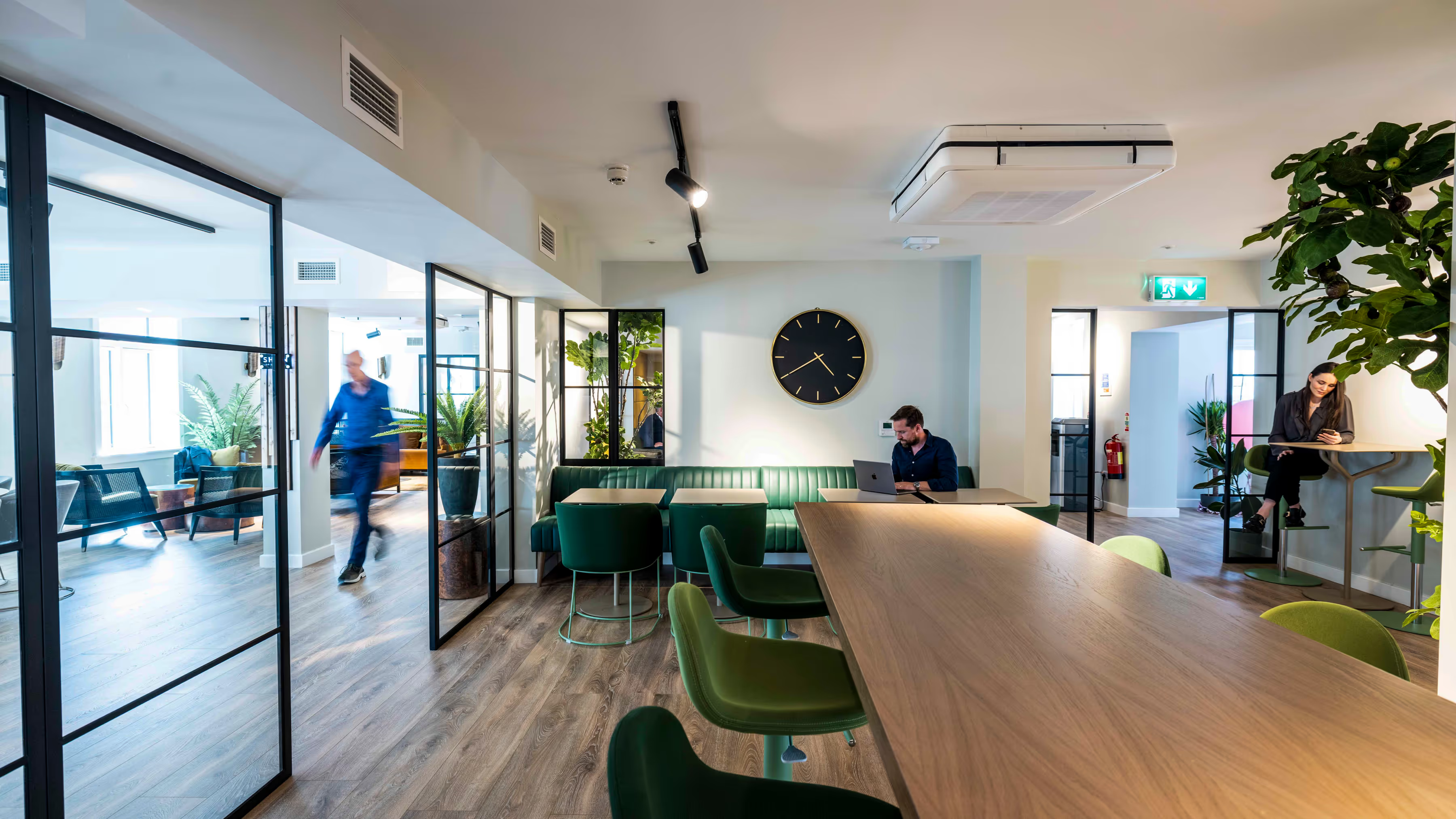
.avif)
Dublin's commercial property market has quietly shifted. Five years ago, signing a five-year lease on a fixed office was just what you did. Today, over 40% of businesses in the city operate from some form of flexible workspace, and that number is still climbing.
Whether you're a startup that needs room to grow, an international company setting up an Irish base, or an established team rethinking how you use space, flexible office space in Dublin is now a serious option..
This guide covers everything: what flexible office space actually means, the different types available, where in Dublin to look, what it costs, and how to evaluate providers before you sign anything.
What Is Flexible Office Space?
Flexible office space is any workspace arrangement that gives you more control over how long you commit, how much space you take, and how you use it. It's the structural opposite of a traditional commercial lease, where you're locked in for years, liable for dilapidations, and responsible for the full cost of fit-out.
In Dublin, "flexible office space" is an umbrella term that covers several distinct formats. The most common are:
- Serviced offices - fully fitted, private offices you can move into immediately, with facilities, IT, and reception managed on your behalf
- Managed offices - private, bespoke spaces designed for your team and operated for you, on flexible terms
- Virtual offices - a professional Dublin address and phone number, without a physical desk commitment
Each suits a different stage of business, budget, and working culture. It's worth understanding each one before deciding which direction to go.
The Main Types of Flexible Office Space in Dublin
- Serviced Offices
A serviced office is a ready-to-use private workspace within a larger managed building. Everything is set up before you arrive: furniture, broadband, phone lines, kitchen facilities, meeting rooms, and usually reception staff. You pay a monthly all-in fee and the provider handles everything else. Serviced offices in Dublin are available on rolling monthly contracts or short-term agreements, typically from three months upward. Most buildings offer a range of office sizes, so you can start small and expand into a larger suite as your team grows without moving buildings.
Best suited to: Teams who want privacy, a professional address, and zero facilities overhead.
- Managed Offices
A managed office is a private, dedicated space built and run for your company specifically but without the capital commitment or long-term liability of a traditional fit-out. In practice: you agree on a term (usually one to three years), specify your requirements; how many desks, what layout, what branding, and fits out. Your name is on the door and it feels entirely like your own office. You just don't own the problem of running it. This model has become particularly popular in Dublin with US and European companies establishing their EMEA headquarters in Ireland. They want a proper branded base that reflects the business (not a generic shared building) but they need commercial flexibility that a ten-year lease can't offer.
Best suited to: Companies who want their own identity and culture in a space, without the risk of a long lease or the cost of self-managed fit-out.
- Virtual Offices
A virtual office gives you a professional Dublin address, mail handling, and usually a local phone number without any physical desk requirement. Some packages include access to meeting rooms on a pay-as-you-go basis. This is a niche product, but it's genuinely useful in specific circumstances: remote companies that need an Irish registered address for legal or client-facing reasons, international businesses testing the Dublin market before committing to physical space, or sole traders who don't want to use a home address on business correspondence.
Best suited to: Remote-first businesses, sole traders, and international companies establishing a legal presence in Ireland.
How Much Does Flexible Office Space in Dublin Cost?
Pricing in Dublin's flexible office market varies widely depending on location, format, building quality, and contract length. A few things to watch when evaluating pricing:
- All-in vs. itemised billing. Some providers quote a low headline rate and then bill separately for broadband, meeting room hours, printing, and reception services. Always ask for a full cost breakdown before comparing providers.
- Contract length discounts. Most providers offer meaningfully lower rates for multi year commitments versus rolling monthly. If you have a reasonable level of certainty about your requirements, it's worth modelling the difference.
- Rates are negotiable. Particularly for larger teams or managed office arrangements, the quoted rate is rarely the final rate. It's always worth asking.
What's Driving the Shift to Flexible Office Space in Dublin?
The move toward flexible workspace in Dublin isn't just a hangover from the pandemic. There are structural reasons why this model has taken hold and why it's likely to remain dominant.
- Headcount is harder to predict than it used to be. Markets move quickly. A company that plans to be 30 people in 18 months might be 50 or 15. A traditional five-year lease punishes both scenarios severely. Flexible space absorbs them. The ability to scale a team up or down without being bound to a fixed floor plate is commercially significant.
- Dublin's talent market demands it. Hybrid working is now the standard expectation across most of Dublin's professional sectors; technology, financial services, consulting, marketing. Offices that are genuinely good to be in, close to public transport, and used for collaboration rather than obligation are what attracts and retains people. Flexible spaces, which compete on quality and environment as a core product feature, tend to be better designed and better located than legacy leased stock.
- International companies need a faster path to market. Dublin is one of the top European destinations for US and Asia-Pacific companies establishing EU operations. The ability to have a functioning, professional Dublin office within days (rather than the months a traditional fit-out requires) is a competitive advantage when moving quickly to establish a presence.
The Hidden Benefits of Flexible Office Space
Beyond the financial case, there are genuine operational and cultural benefits to flexible workspace that don't always make it into the cost comparison.
- Network and community. In a well-run coworking or serviced office building, you're working alongside other businesses. The best operators actively facilitate connections; through events, introductions, and shared amenities that create organic interaction. For early-stage companies and those new to Dublin, this can be genuinely valuable.
- Operational simplicity. Every hour your management team spends dealing with office facilities, maintenance contracts, or cleaning schedules is an hour not spent on the business. Flexible office providers take all of that off your plate by design.
- Business continuity. If you outgrow your space, or need to downsize, or your team shifts to a different part of the city, you have options. That optionality has a real value that doesn't show up in a simple monthly cost comparison.
- Professional credibility. A registered address in a well-known Dublin building carries weight in certain industries and with certain clients. For international businesses especially, the address signals stability and seriousness.
What to Look for When Choosing a Provider
Dublin has no shortage of flexible office providers. The quality and approach varies considerably. Here's what to evaluate before you commit:
- Contract terms and flexibility
This is the most important variable. Read the contract carefully. Some providers advertise flexibility but include minimum 12-month commitments, restrictive break clauses, or punishing exit terms in the small print. Understand exactly what notice period you're working with and what it costs to leave early. - Included services vs. extras
Get a full cost breakdown, not just the headline rate. Ask specifically about: broadband speed and whether it's dedicated or shared, meeting room hours included per month, printing and admin support, and reception services. - Building quality and facilities
Visit in person before committing. Photos are optimistic. Check the quality of the internet connection, the state of the meeting rooms, whether the kitchen is actually maintained, and whether the common areas feel like a place people want to be. - Scalability
If your team grows, can the provider accommodate you? Moving offices is disruptive and expensive. A provider who can offer you a larger suite as you scale is worth prioritising. - Location for your team
A prestigious address is irrelevant if half your team can't get there easily. Map out where your people actually live and commute from before deciding on location. Dublin's traffic and public transport make this a more material decision than it might appear. - The community and culture of the building
This matters more than it sounds. Who else is in the building? Is it a mix of businesses you'd want to be associated with? Does the provider run events or facilitate introductions? The ambient network in your building has real value, particularly if you're building a team or a client base in the city.
Common Mistakes When Renting Flexible Office Space in Dublin
Even in a flexible market, it's easy to make decisions that cost you time and money. Here are the most common ones to avoid:
- Taking the first thing you see. Dublin's flexible office market is large and varied. The first provider you speak to will always have something available. Shop around, compare properly, and visit multiple buildings before making a decision.
- Underestimating how quickly you'll outgrow the space. Teams grow faster than you expect. If you're early-stage or actively hiring, take more space than you think you need right now, or make sure your provider can move you up easily.
- Not reading the contract. Flexible doesn't mean no obligations. Some contracts are genuinely flexible; others use the word liberally. Know exactly what you're committing to.
- Ignoring the IT setup. Broadband quality is existential for most businesses today. A slow or unreliable connection in a beautiful building is a disaster waiting to happen. Ask for a Speedtest, ask how bandwidth is shared across the building, and ask what the provider's SLA is if there's an outage.
How to Get Started
If you're ready to start looking at flexible office space in Dublin, here's a practical sequence:
- Define your requirements first. How many desks do you need now, and what's your realistic headcount in 12–18 months? What matters more, privacy or community? Do you need 24/7 access? Is parking critical?
- Shortlist locations that work for your team. Map your team's commutes, your client meeting locations, and your key transport preferences before narrowing to a postcode.
- Get proper quotes, not just rates. Ask every provider for a full cost breakdown including all potential extras, the full contract terms, notice period, and what happens if you need to scale up or down.
- Visit in person. No amount of website photography substitutes for spending 30 minutes in the building. Notice whether it's busy, whether people seem to like being there, and whether the facilities match what was promised.
Dublin's flexible office market is well-developed, competitive, and genuinely good value compared to equivalent markets in London or Amsterdam. With the right approach, you can find a space that works for your business today and gives you room to grow.