
If you're looking for office space in Dublin in 2026, monthly rent is probably the first number you check. It shouldn't be the only one.
A traditional lease can look cheaper on paper when you compare its advertised rent per square foot to a serviced office's monthly price. But the headline rent rarely tells you what the office will actually cost. Add fit-out, furniture, utilities, service charges, cleaning, insurance, maintenance, meeting rooms, internet, commercial rates and possible dilapidation costs and the numbers can look very different.
That's why more businesses are comparing serviced and traditional offices by total cost of occupation, not rent alone. For a professional Dublin address without the extra overhead, a flexible office can be a simpler way to manage workspace costs.
Dublin office costs in 2026
Dublin's office market is still competitive, especially for good-quality city-centre space. CBRE reported prime headline office rents of €67.50 per sq ft in Q2 2026, forecasting around €70 per sq ft by year end. Colliers put prime rents for existing Grade A CBD space at roughly €65–€70 per sq ft.
Useful figures for comparing commercial property, but not the full cost of running an office. A traditional lease can also involve fit-out and design, furniture and equipment, broadband and IT infrastructure, electricity and heating, cleaning, building service charges, commercial rates, insurance, repairs and maintenance, meeting room facilities, professional and legal fees and possible dilapidation costs when the lease ends.
So the real question isn't "what's the rent per square foot?" It's "what will this office cost my business every month and over the life of the agreement?"
What is a traditional office lease?
A traditional lease gives your business a dedicated commercial property, or part of one. For an established company with predictable headcount, a long-term lease can make sense — you control the space and can shape it around your business.
That control comes with responsibility, though. You'll likely need to organise the fit-out, buy furniture, arrange internet and utilities, manage suppliers, and handle ongoing maintenance, on top of whatever building costs the lease doesn't cover. The initial capital outlay can be significant, and once you've invested in the space, changing course isn't simple.
The hidden cost of fitting out an office
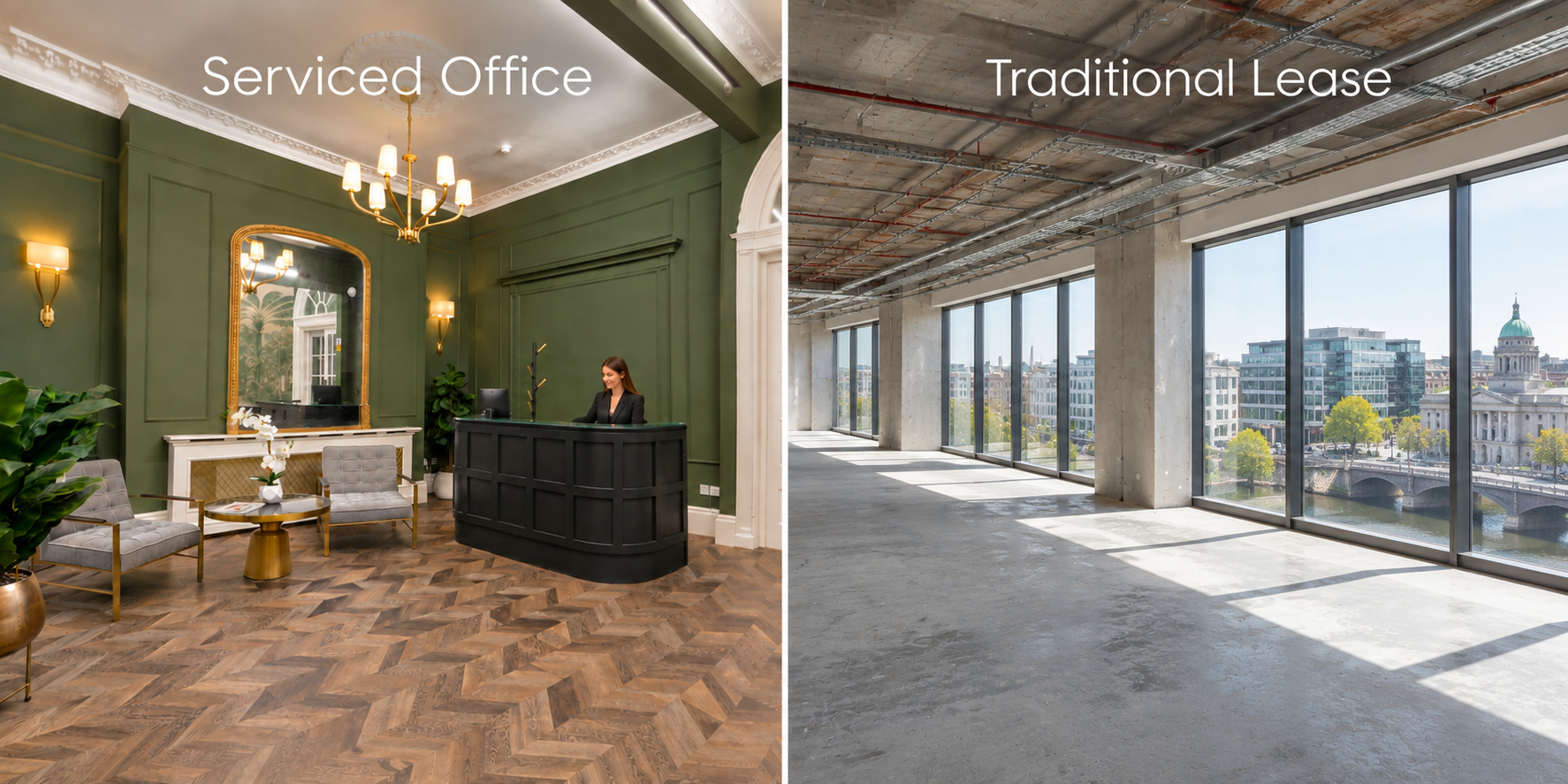
The biggest difference between a traditional lease and a serviced office shows up before your team even moves in.
A traditional office may need architects, designers or project managers for the initial layout. You'll likely be buying desks, chairs, storage, meeting tables and breakout furniture, plus installing internet cabling, meeting-room screens and phones. Even kitchen equipment and appliances add to the bill. And the cost that's easiest to overlook is time: the hours your team spends managing the whole project.
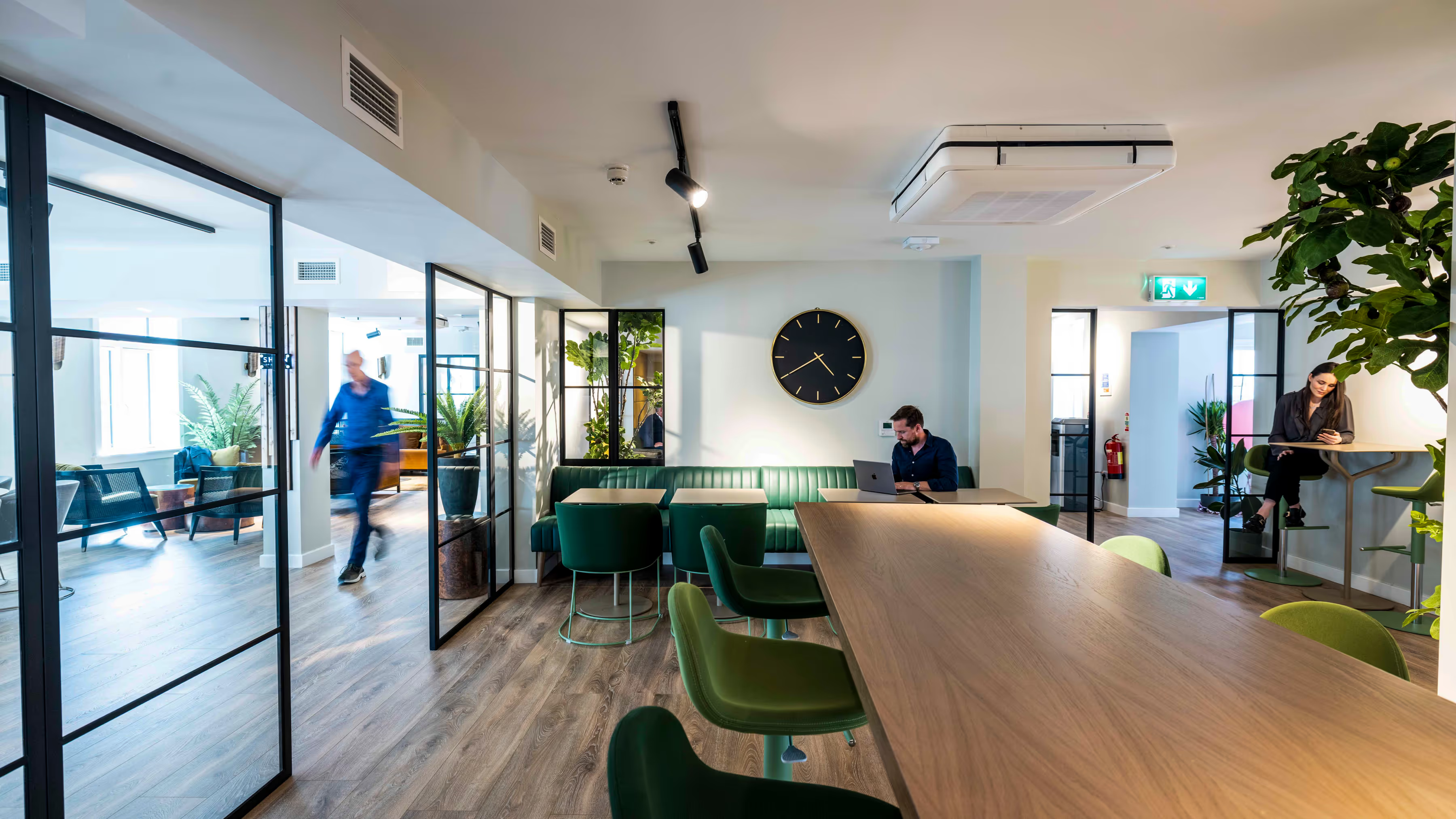
A serviced office skips most of this, since the space is already furnished, connected and operational. At Pembr, for example, the monthly fee covers office setup, high-speed internet, meeting room access, reception services, facility maintenance, cleaning and complimentary tea and coffee — so you can focus on getting your business into the office rather than getting the office ready.
Serviced office vs. traditional lease: the true cost
What about a 10-year office lease?
Long commercial leases have traditionally been common in Dublin, but businesses now have to think carefully about how much space they'll actually need in five or ten years. Your team might grow or shrink. Hybrid working might change your desk count. You could acquire a company, restructure or move to a different part of Dublin.
A long lease makes those changes harder to accommodate, which is part of why flexible office space has become more relevant for growing businesses. Instead of locking into a fixed footprint for years, you can pick a space that works now and reassess as the business changes. Pembr offers private offices for teams of various sizes, with flexible terms depending on the space.
Don't forget dilapidations
Dilapidations are another cost worth understanding before signing a traditional lease. At the end of the term, tenants may be responsible for the condition of the property, depending on the agreement — that can mean costs for repairs or returning the premises to an agreed state and these are hard to predict years in advance.
With a serviced office, the building and day-to-day facilities stay largely the operator's responsibility rather than yours, which makes budgeting considerably easier.
Why an all-inclusive office makes budgeting easier
Instead of separate bills for every part of your workplace, an all-inclusive model rolls those costs into one monthly payment. Pembr's pricing is built on that principle: internet, office setup, meeting room access, reception, maintenance and cleaning are all part of the monthly fee. Some extras, like parking, signage or printing, may cost more depending on location, so it's worth checking what's included before signing. That clarity matters when you're planning a budget.
Flexible office space isn't just for startups
There's still a perception that serviced offices are mainly for freelancers and small startups. That's no longer accurate. Flexible offices work for established companies, professional services firms, growing teams, project teams and businesses opening a Dublin location for the first time — and for companies that don't want to sink capital into a large fit-out.
Take a 10-person team that eventually needs 20 desks. With a traditional lease, that might mean taking on more space, renegotiating or moving entirely. With flexible workspace, resizing your office is usually far more straightforward, depending on availability and terms.
So, which office model costs less?
There's no single answer. A traditional lease suits companies with predictable, long-term space needs that want full control over their premises. A serviced office suits businesses that value flexibility, predictable monthly costs, speed and lower upfront investment.
The mistake is comparing rent against rent. Instead, compare rent plus fit-out, furniture, utilities, service charges, internet, cleaning, maintenance, rates, professional fees and potential exit costs, against one predictable monthly serviced-office fee plus any clearly stated extras. That's the comparison that actually matters.
Before signing anything, ask: What's the total monthly cost? Which utilities are included? Is internet included? Is the office furnished? Are meeting rooms included? Who handles repairs and maintenance? Is cleaning included? Are commercial rates included? What's the minimum term? What happens if you need more or less space? Are there extra charges for meeting rooms, parking or printing? What costs apply when the agreement ends?
Clear answers to these make comparing Dublin office spaces much easier.
The real value of a flexible office in Dublin
A flexible office isn't necessarily always cheaper than a traditional lease — its real advantage is a simpler cost structure. You're paying for a ready-to-use workplace instead of taking on responsibility for every part of running a commercial office. In Dublin 2, where demand for quality office space remains strong and supply stays tight, that difference matters.
A growing business doesn't just need an office that works today. It needs a workspace that can keep pace with it.
The bottom line
The cheapest-looking office isn't always the cheapest to operate. A traditional lease might offer an attractive headline rent, but once you add fit-out, furniture, utilities, service charges and maintenance, the real figure can run considerably higher. A serviced office bundles many of those costs and responsibilities into one solution, so you can move in faster, manage costs more easily and adapt your space as your needs change.
For businesses weighing serviced offices against traditional leases in Dublin in 2026, the smart starting point isn't the advertised rent. It's the total cost of occupation. If flexibility, simplicity and predictable monthly costs matter to your business, it's worth looking beyond the traditional lease.